
NITI Aayog ATL Grants: ₹20 Lakh Funding, Tranche 1–3 Disbursement & Setup Guide (2026)

1. Understanding the NITI Aayog Atal Tinkering Lab (ATL) Scheme
The Atal Tinkering Lab (ATL) initiative is the Government of India’s premier innovation framework executed by the Atal Innovation Mission (AIM), NITI Aayog. Its core purpose is to cultivate scientific curiosity, creative problem-solving, and computational agility among students in Classes 6 through 12 using do-it-yourself (DIY) maker kits and emerging 21st-century technological tools.
Under the scheme, every sanctioned school is awarded an aggregate Grant-in-Aid of ₹20,00,000 (Twenty Lakh Rupees). The grant is structured into two distinct financial compartments: a one-time capital establishment grant of ₹10.00 Lakh for procuring mandated Package 1-4 lab hardware, and ₹10.00 Lakh in operational and maintenance (O&M) funds distributed at ₹2.00 Lakh per annum across five operational years.
During the initial year of sanction, schools receive a lump sum of ₹12.00 Lakhs directly into their dedicated PFMS account. Strict compliance with procurement categories and electronic accounting is necessary to guarantee uninterrupted release of subsequent annual installments.
2. School Eligibility & Infrastructure Prerequisites for ATL Selection
📌 Mandatory Physical Boundary: The designated 1,500 sq. ft. area cannot be a shared or partitioned room inside an existing physics, chemistry, or general computer lab; it must function as a standalone maker space.
3. ₹20 Lakh Grant Tranche Disbursement & Expenditure Breakdown
The disbursement framework and permissible expenditure heads established by NITI Aayog are tracked electronically via PFMS:
4. Mandatory ATL Equipment Packages (Package 1 to 4 Specifications)
NITI Aayog prescribes an exhaustive, curriculum-aligned inventory divided into four functional packages:
1Package 1: Electronics, DIY STEM & Microcontroller Kits
Core Electronic Workstations- Arduino UNO, Nano, ESP32, and BBC micro:bit microcontroller boards with USB cables
- Solderless breadboards, assorted jumper wires, resistors, capacitors, LEDs, and buzzer modules
- Relay modules, L298N motor drivers, geared DC motors, servo motors, and stepper motors
- Digital multimeters, regulated DC bench power supplies (0-30V, 5A)
- Temperature-controlled soldering stations, lead-free solder wire, and desoldering pumps
2Package 2: 3D Printing & Rapid Prototyping Hardware
Digital Fabrication Corner- Fused Deposition Modeling (FDM) 3D Printer (Min. 200x200x200 mm build volume, heated bed, auto-leveling)
- Non-toxic, biodegradable PLA and PETG filament spools in assorted primary colors
- 3D printing post-processing kit (precision scrapers, nozzle clean needles, heat-resistant tape)
- Installed open-source slicing software (UltiMaker Cura / PrusaSlicer) on lab workstations
3Package 3: Mechanical & Carpentry Maker Tools
Heavy Making Workbench- Electric hand drill machine with high-torque drill bit set and bench drill stand
- Hand tools: Wire strippers, combination pliers, precision screwdriver sets, hacksaw, ball-peen hammer
- Heavy-duty bench vice, digital vernier callipers, steel measuring tapes, and industrial hot glue guns
- Safety gear: Anti-cut gloves, impact-resistant safety goggles, heat-resistant aprons, and first aid kit
4Package 4: Advanced Sensors, IoT & AI Drone Modules
Next-Gen Research Corner- Ultrasonic, IR, PIR motion, LDR light, soil moisture, and gas/smoke detection sensors
- IoT communication modules (Wi-Fi, Bluetooth BLE, LoRa) and serial camera modules
- DIY programmable educational quadcopter drone assembly kit with flight simulator software
- Raspberry Pi 4 / 5 single-board computers preloaded with Linux, Python, and computer vision libraries
5. Step-by-Step PFMS Setup & Tranche Release Process
To claim the ₹12.00 Lakh first tranche and secure recurring annual maintenance disbursements, schools follow this sequence:
Selection Notification & MyGov / AIM Verification
🔗 aim.gov.inThe school receives an official sanction letter containing a unique ATL UID from the Atal Innovation Mission, NITI Aayog.
Execution of Memorandum of Agreement (MoA) & Indemnity Bond
🔗 ATL Compliance PortalThe school executes the bilateral MoA. Private trusts/societies must submit an Indemnity Bond registered on non-judicial stamp paper.
Dedicated Bank Account & PFMS Scheme Mapping
🔗 pfms.nic.inThe school opens an independent savings bank account in a nationalized bank and maps it under Scheme [0217] - Atal Innovation Mission on PFMS.
Tranche-1 Direct Credit (₹12 Lakhs Upfront)
🔗 PFMS Electronic TransferThe central treasury executes an electronic direct bank transfer of ₹10 Lakhs (Capital) + ₹2 Lakhs (Year-1 O&M) into the mapped account.
Commissioning & Teacher Master Training
🔗 On-site ATL RoomThe school purchases Packages 1–4 from a verified turnkey partner like CSEEL, installs equipment, trains teachers, and formally inaugurates the lab.
Monthly Reporting & Tranche 2/3 UC Submission
🔗 atl.aim.gov.inThe school submits monthly activity metrics on the AIM dashboard and uploads a CA-certified Form GFR 12-A to unlock subsequent annual ₹2 Lakh tranches.
6. Strict Financial Audit Rules & Mandatory Record-Keeping
⚠️ Legal & Recovery Notice: Retaining grant funds in savings accounts to earn bank interest without commissioning the laboratory within 12 months triggers statutory recovery proceedings by NITI Aayog with 18% penal interest.
Frequently Asked Questions (FAQ)
Does Tranche 1 disburse the entire ₹12 Lakhs in a single installment?
Yes. Upon successful completion of MoA execution, indemnity bond verification, and PFMS Scheme [0217] mapping, the central treasury deposits ₹10 Lakh (Capital Setup) and ₹2 Lakh (Year-1 O&M) simultaneously.
Are private unaided schools eligible for NITI Aayog ATL Grants?
Yes. Private schools registered under non-profit educational societies or charitable trusts are fully eligible, provided they hold active registration on the NGO-DARPAN portal and submit a registered indemnity bond.
What are the core prerequisites to unlock Tranche 2 (Year-2 ₹2 Lakh)?
The institution must demonstrate at least 75% utilization of the initial ₹12 Lakh grant, submit an audited Form GFR 12-A Utilization Certificate, and maintain a consistent monthly reporting record on the AIM dashboard.
Does CSEEL provide end-to-end Package 1 to 4 commissioning and training?
Yes. CSEEL supplies 100% NITI Aayog compliant 3D printers, robotics modules, electronic kits, tools, and sensors, accompanied by a 3-day on-site faculty training program and continuous 5-year mentorship support.
Can a school apply if it has less than 1,500 sq. ft. of available floor area?
For schools located in plain regions, 1,500 sq. ft. is mandatory (which can be two interconnected or adjacent rooms). A concession of 1,000 sq. ft. is granted specifically to institutions in designated hilly or northeastern states.
Devendra Singh
Guided over 180+ institutions across India through ATL application, PFMS registration, Package 1-4 equipment commissioning, and Tranche 2/3 UC approvals.
Explore Other School Lab Solutions
Beyond Composite Science Labs, CSEEL designs and equips turnkey NEP 2020 and NITI Aayog aligned innovation labs across India.
 NITI Aayog (P1–P4)
Atal Tinkering Lab (ATL)
Turnkey setup for NITI Aayog AIM packages with 3D printers, electronics, and rapid prototyping.
- Packages P1 to P4 complete hardware & 3D printers
- Arduino, sensors, mechanical tools & mentor training
 CBSE Skill 417 & 843
Artificial Intelligence & ML Lab
Future skills lab with computer vision rigs, edge AI accelerators, and Python neural network tools.
- Edge AI vision cameras & Coral accelerators
- Python SDK, OpenCV & hands-on student projects
 Circular Skill-75/2024
Composite Skill Lab
Mandatory vocational lab for Classes 6–12 with AI, coding, robotics, and 33 CBSE skill subjects.
- Option A (600 sq ft) or Option B (2x 400 sq ft)
- 33 vocational modules including AI Code 417 & 843
 Senior Secondary (11–12)
Advance Composite Science Lab
High-end interdisciplinary research lab with analytical spectrophotometers and research microscopes.
- Digital spectrophotometer, research microscopes & centrifuge
- Fume exhaust hood & Class 11-12 research stations
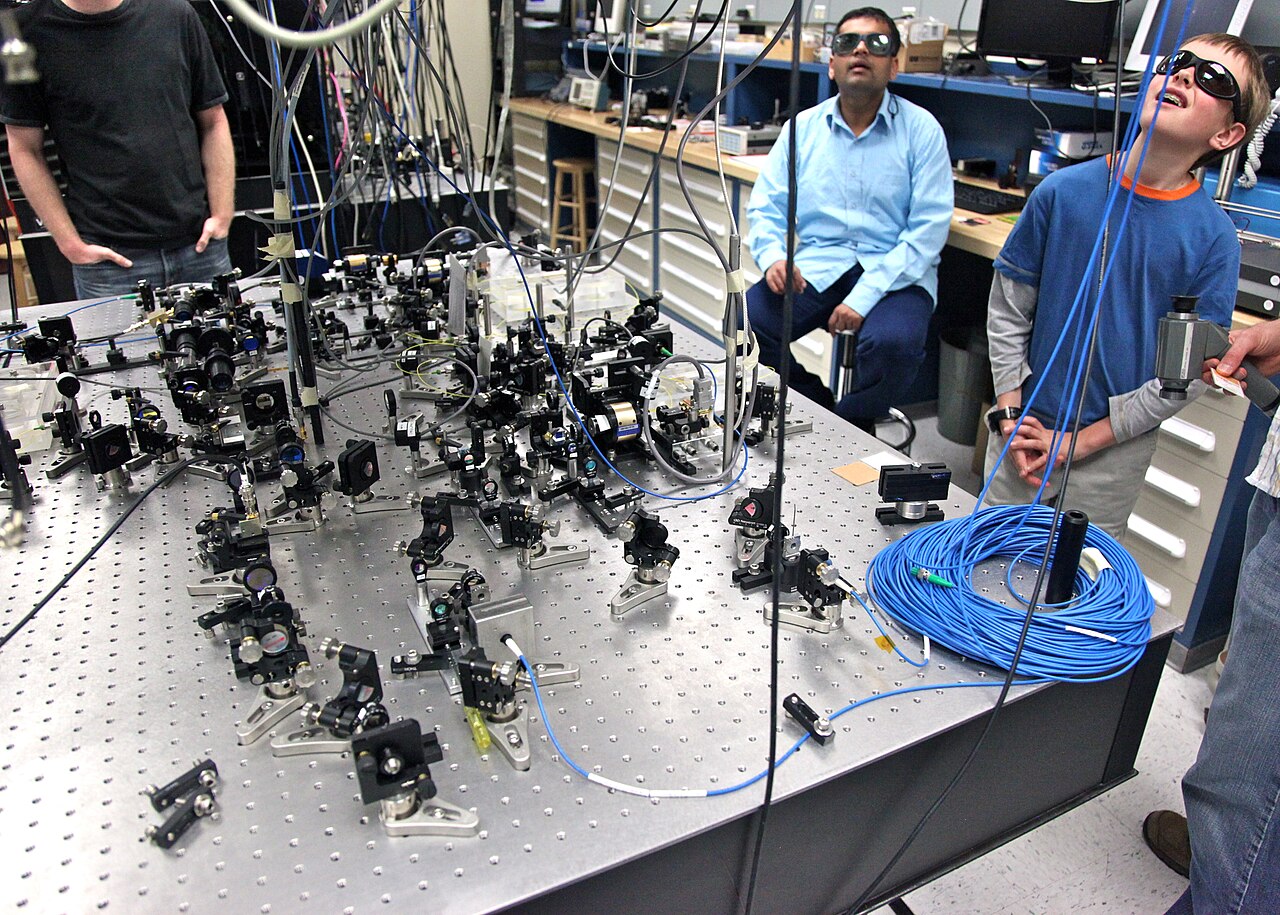 ISRO Space Aligned
Astronomical & Space Lab
Interactive celestial observatory with motorized GoTo telescopes, solar filters, and planetarium software.
- Motorized 8" Schmidt-Cassegrain tracking telescope
- H-alpha solar filter, digital planetarium & astrophotography
DGCA Micro-AviationAerospace & Drone Lab
Aeronautical wind tunnel simulators, modular quadcopter kits, flight simulators, and safety net cage.
- Modular DIY multirotor drone kits & flight simulators
- Wind tunnel lift/drag test kits & flight safety netting
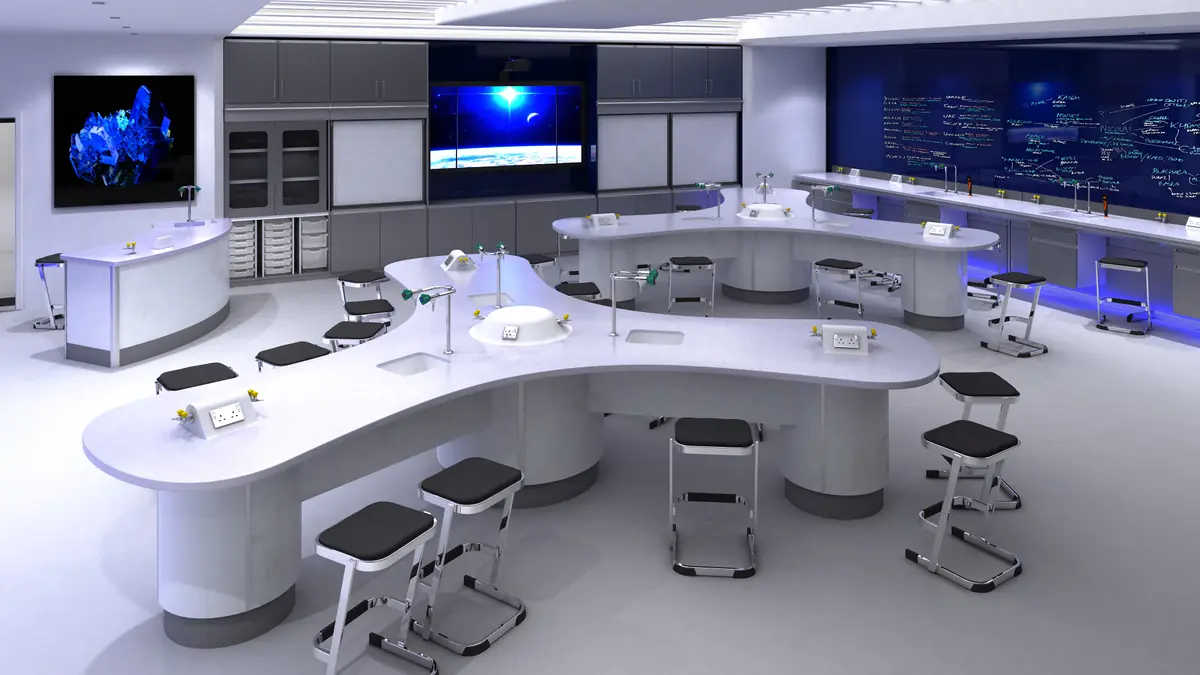 Industry 4.0 Robotics
Robotics & IoT Super-Lab
Industrial kinematics, multi-sensor autonomous rovers, smart IoT cloud, and WRO competition tracks.
- 4-DOF/6-DOF robotic arms & autonomous rovers
- ESP32 wireless mesh & World Robot Olympiad mats
 NEP 2020 Makerspace
Design Thinking & Innovation Lab
Human-centric design studio with enclosed laser cutters, vinyl plotters, and woodworking workbenches.
- Enclosed laser cutter/engraver & vinyl plotter
- Heavy-duty ergonomic maker workbenches & tool kits
 Spatial Computing
AR / VR Immersive Science Lab
Virtual reality suites for 3D molecular biology, virtual dissections, and risk-free hazardous chemistry.
- Standalone 6-DoF VR headsets with teacher dashboard
- Virtual anatomy & chemistry simulations with zero hazard
 CBSE Math Lab Norm
Vedic & Experiential Math Lab
Eliminates math phobia through tactile geometric proof solids, algebra tiles, clinometers, and abacus.
- Tactile pythagoras models, algebra tiles & clinometers
- Vedic arithmetic abacus & chapter-wise NCERT kits
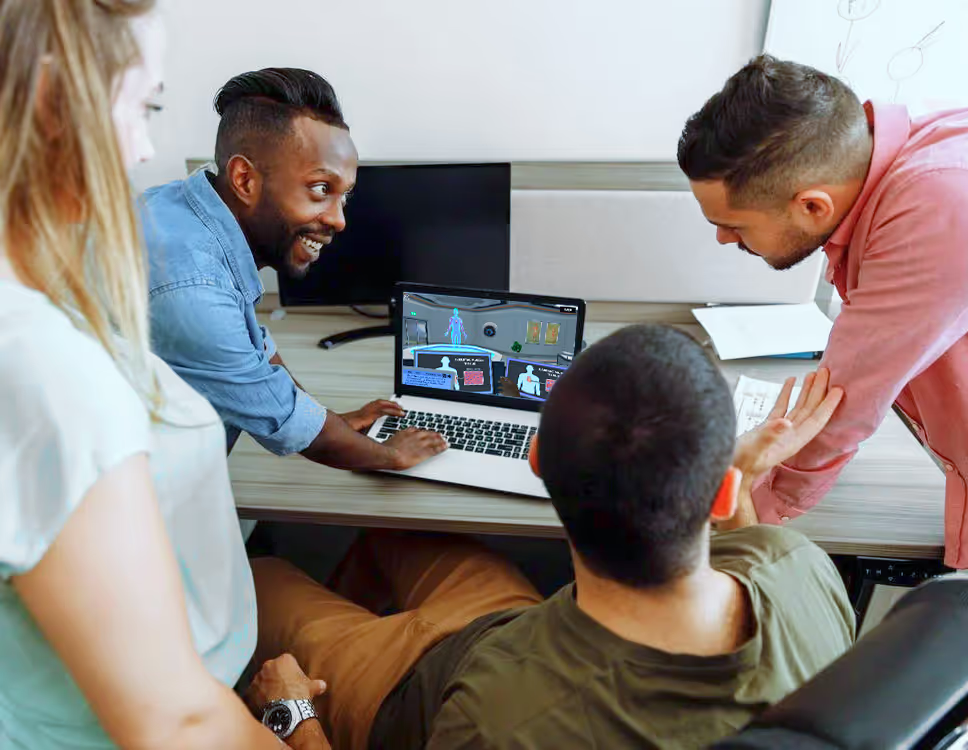 Digital Phonetics
Language & Phonetics Lab
Interactive acoustic booths with AI-powered pronunciation waveforms, debate recording, and fluency trainers.
- Student audio terminals with master teacher console
- Real-time voice waveform matching for neutral accent
Planning Multiple Labs for CBSE Affiliation or PM SHRI Grant?
CSEEL offers integrated turnkey packages for Composite Labs, Atal Tinkering Labs (ATL), AI & Robotics Suites under a single audit-ready warranty with 3D CAD plans.