
Samagra Shiksha Abhiyan: Composite School Grant & Science Lab Infrastructure Norms (2026)

1. What is Samagra Shiksha Abhiyan & How Does It Fund School Labs?
Samagra Shiksha is an overarching national program for the school education sector spanning pre-school to class 12. Formulated in direct alignment with the National Education Policy 2020, it subsumes three erstwhile flagship centrally sponsored schemes: Sarva Shiksha Abhiyan (SSA), Rashtriya Madhyamik Shiksha Abhiyan (RMSA), and Teacher Education (TE).
Under the infrastructure strengthening component of Samagra Shiksha, secondary and senior secondary schools receive targeted financial assistance to eliminate infrastructure deficiencies. The program specifically mandates that school laboratories must not remain static "showpieces", but should function as active experiential hubs equipped with continuous water supply, standardized apparatus, chemical consumables, and safety provisions.
Funding is disbursed through two primary streams: the annual recurring "Composite School Grant" (CSG) scaled according to UDISE+ student enrollment for routine lab maintenance and chemical consumables, and dedicated capital development grants approved by the Project Approval Board (PAB) for establishing new Integrated Science Laboratories.
2. Enrolment-based Grant Slabs (Composite School Grant Framework)
🔔 Mandatory 10% Swachhta Head: Under Samagra Shiksha guidelines, a minimum of 10% of the Composite School Grant must be dedicated specifically to sanitation, lab wash sinks, and safe drainage upkeep.
3. Allowable Expenditure Heads for Science Laboratories
School Development and Management Committees (SDMCs) are legally authorized to disburse funds under the following approved operational heads:
4. Samagra Shiksha Physical Laboratory Standards
When establishing or upgrading secondary laboratories under state PAB allocations, schools must satisfy the following physical benchmarks:
1Secondary Composite Science Laboratory
Min. 500 to 600 Sq. Ft.- Concrete or wooden worktables topped with chemical-resistant black Kadappa or granite stone
- Minimum 4 to 8 stainless steel or ceramic sinks with continuous pressurized running water
- Acid-resistant drainage manifold connected to an external neutralizer soak pit
- Full inventory of 49 NCERT/CBSE mandated non-consumable apparatus
- Wall-mounted bilingual periodic tables, safety charts, and first-aid station
2ICT & Digital Science Demonstration Space
Integrated within Lab or 400 Sq. Ft.- Smart TV display or digital projector with screen for virtual lab simulations
- Teacher computing terminal preloaded with NCERT digital curriculum content
- Compound microscope equipped with a USB digital camera eyepiece for whole-class display
5. Sanction, Procurement & Accounting Process through SMC
Grant utilization is managed transparently through community-driven School Management Committees:
SMC / SDMC Resolution & Requirement Assessment
🔗 SMC Minute BookThe science faculty submits an itemized inventory requirement; the SMC convenes an official meeting and adopts a formal approval resolution.
Direct Credit via PFMS into School Account
🔗 PFMS SystemThe State Project Directorate credits funds directly into the school’s account under the Samagra Shiksha Single Nodal Account (SNA) banking framework.
Purchase through GeM or Local Procurement Committee
🔗 GeM / Local Purchase CommitteeEquipment and chemicals are ordered through the Government e-Marketplace (GeM) or competitive quotations adhering to state financial rules.
Stock Entry & Headmaster Verification
🔗 Physical Stock RegisterAll procured apparatus and chemical containers are cataloged in the Master Stock Register with physical signatures and asset markings.
Submission of Utilization Certificate & PRABANDH Upload
🔗 PRABANDH PortalThe Head of School uploads audited vouchers and submits a signed Utilization Certificate to the Block Education Officer (BEO).
6. Audits, Social Audits & Prohibited Expenditures
📌 Regulatory Directive: Issuing advance payments to unverified local vendors without prior goods inspection is strictly prohibited under state financial protocols.
Frequently Asked Questions (FAQ)
Is the Composite School Grant (CSG) automatically disbursed every academic year?
Yes, provided the institution has uploaded the prior financial year’s Utilization Certificate (UC) and verified its enrollment numbers on the UDISE+ portal.
Are private unaided schools eligible for Samagra Shiksha lab grants?
No. Samagra Shiksha infrastructural and composite grants are reserved exclusively for government, local body, and government-aided institutions.
Can government high schools procure lab materials from CSEEL under Samagra Shiksha?
Yes. Schools can place orders with CSEEL through the Government e-Marketplace (GeM) portal or under state procurement guidelines for approved apparatus kits and borosilicate glassware.
Can the grant be utilized to install running water plumbing and sinks in the science lab?
Yes. Upgrading laboratory sinks, water supply pipes, and drainage traps is fully permissible under the minor repair and Swachhta (10%) budget heads.
Devendra Singh
Expert in State Education Project Directorate norms, Samagra Shiksha civil/lab interventions, Swachhta Action Plan allocations, and SMC procurement frameworks.
Explore Other School Lab Solutions
Beyond Composite Science Labs, CSEEL designs and equips turnkey NEP 2020 and NITI Aayog aligned innovation labs across India.
 NITI Aayog (P1–P4)
Atal Tinkering Lab (ATL)
Turnkey setup for NITI Aayog AIM packages with 3D printers, electronics, and rapid prototyping.
- Packages P1 to P4 complete hardware & 3D printers
- Arduino, sensors, mechanical tools & mentor training
 CBSE Skill 417 & 843
Artificial Intelligence & ML Lab
Future skills lab with computer vision rigs, edge AI accelerators, and Python neural network tools.
- Edge AI vision cameras & Coral accelerators
- Python SDK, OpenCV & hands-on student projects
 Circular Skill-75/2024
Composite Skill Lab
Mandatory vocational lab for Classes 6–12 with AI, coding, robotics, and 33 CBSE skill subjects.
- Option A (600 sq ft) or Option B (2x 400 sq ft)
- 33 vocational modules including AI Code 417 & 843
 Senior Secondary (11–12)
Advance Composite Science Lab
High-end interdisciplinary research lab with analytical spectrophotometers and research microscopes.
- Digital spectrophotometer, research microscopes & centrifuge
- Fume exhaust hood & Class 11-12 research stations
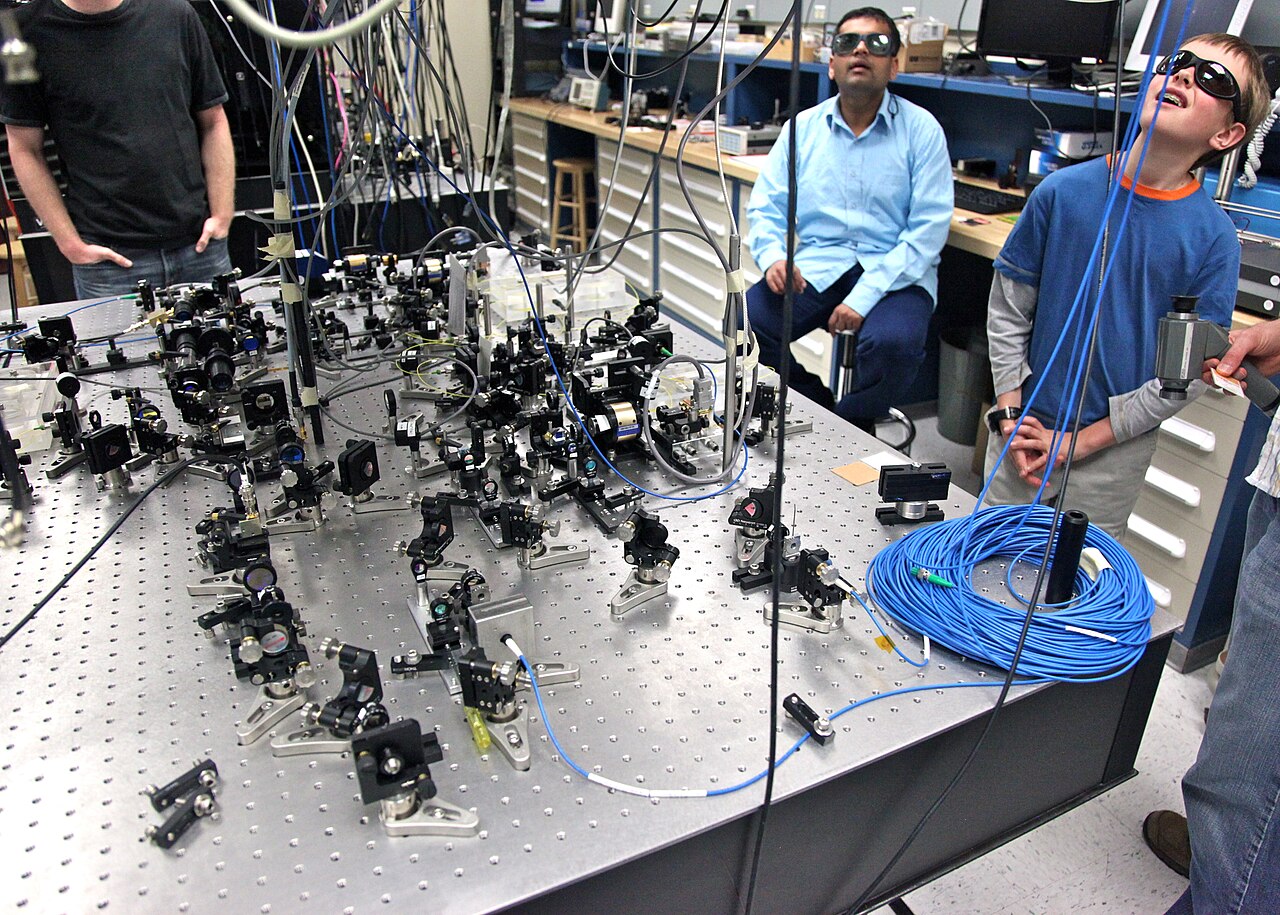 ISRO Space Aligned
Astronomical & Space Lab
Interactive celestial observatory with motorized GoTo telescopes, solar filters, and planetarium software.
- Motorized 8" Schmidt-Cassegrain tracking telescope
- H-alpha solar filter, digital planetarium & astrophotography
 DGCA Micro-Aviation
Aerospace & Drone Lab
Aeronautical wind tunnel simulators, modular quadcopter kits, flight simulators, and safety net cage.
- Modular DIY multirotor drone kits & flight simulators
- Wind tunnel lift/drag test kits & flight safety netting
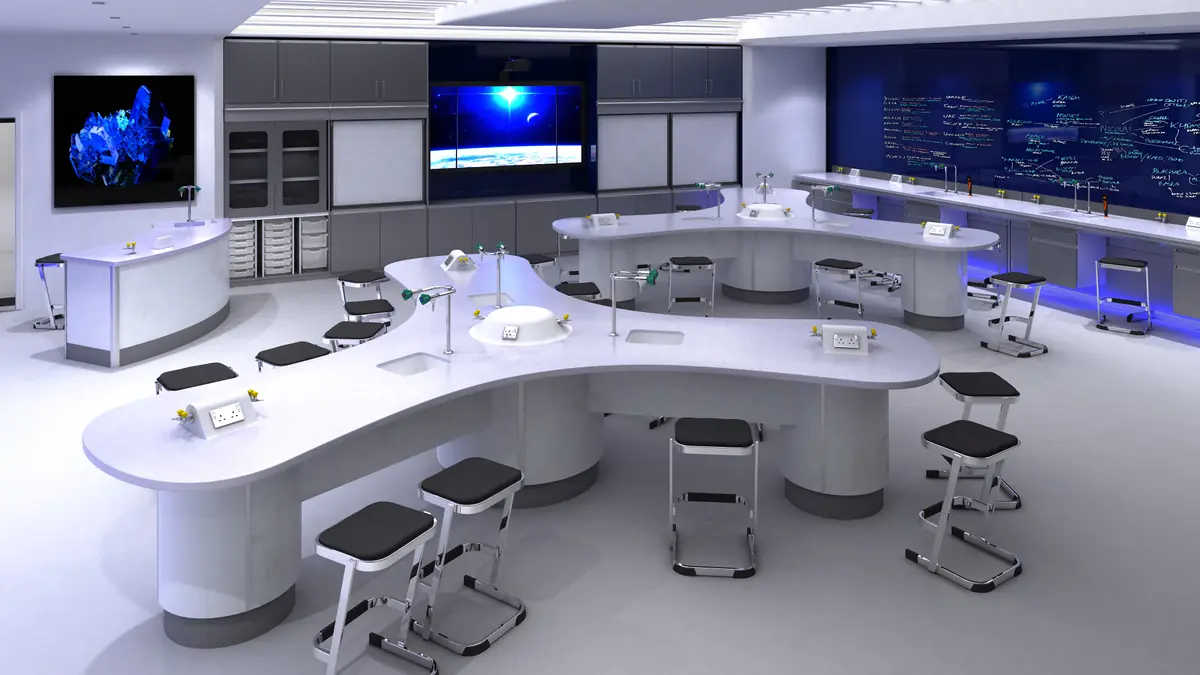 Industry 4.0 Robotics
Robotics & IoT Super-Lab
Industrial kinematics, multi-sensor autonomous rovers, smart IoT cloud, and WRO competition tracks.
- 4-DOF/6-DOF robotic arms & autonomous rovers
- ESP32 wireless mesh & World Robot Olympiad mats
 NEP 2020 Makerspace
Design Thinking & Innovation Lab
Human-centric design studio with enclosed laser cutters, vinyl plotters, and woodworking workbenches.
- Enclosed laser cutter/engraver & vinyl plotter
- Heavy-duty ergonomic maker workbenches & tool kits
 Spatial Computing
AR / VR Immersive Science Lab
Virtual reality suites for 3D molecular biology, virtual dissections, and risk-free hazardous chemistry.
- Standalone 6-DoF VR headsets with teacher dashboard
- Virtual anatomy & chemistry simulations with zero hazard
 CBSE Math Lab Norm
Vedic & Experiential Math Lab
Eliminates math phobia through tactile geometric proof solids, algebra tiles, clinometers, and abacus.
- Tactile pythagoras models, algebra tiles & clinometers
- Vedic arithmetic abacus & chapter-wise NCERT kits
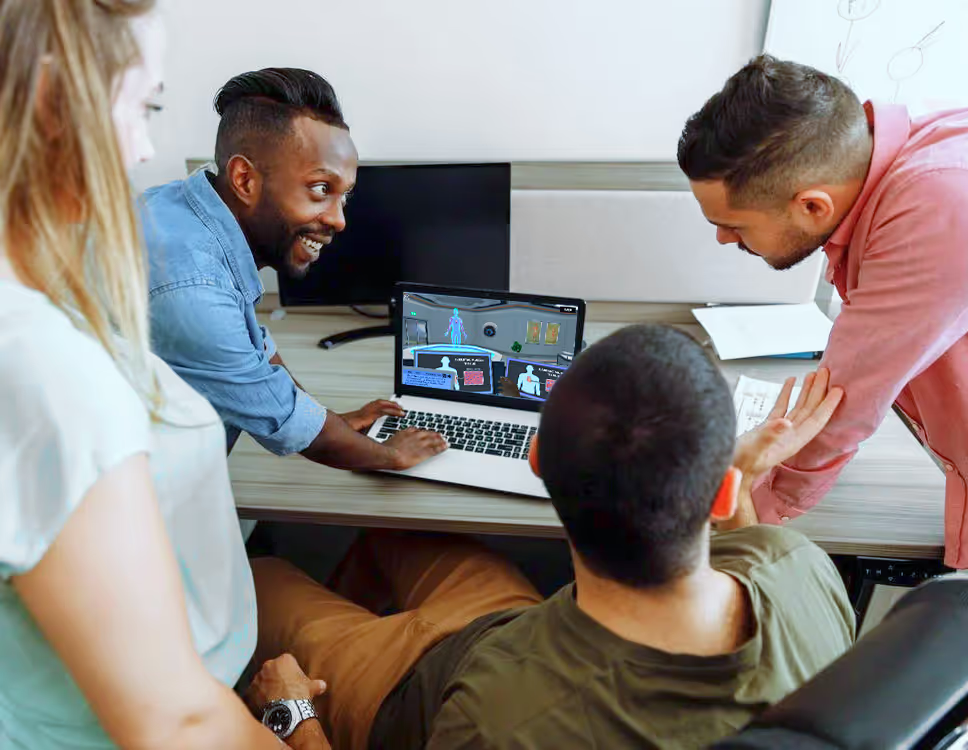 Digital Phonetics
Language & Phonetics Lab
Interactive acoustic booths with AI-powered pronunciation waveforms, debate recording, and fluency trainers.
- Student audio terminals with master teacher console
- Real-time voice waveform matching for neutral accent
Planning Multiple Labs for CBSE Affiliation or PM SHRI Grant?
CSEEL offers integrated turnkey packages for Composite Labs, Atal Tinkering Labs (ATL), AI & Robotics Suites under a single audit-ready warranty with 3D CAD plans.