Science & Mathematics
Engineering, Maker & STEAM Arts
Student Projects & Schematics
•Complete Makerspace CatalogCatalog•Prototyping & Digital Fabrication•Hand & Power Tools WorkshopStudent Projects & Schematics
•Working Science Fair Prototypes•Innovation Schematics & BOM•Student Innovation ShowcaseApparatus Catalog & Lab Packages
Procurement & Institutional Cart
Directory & Discovery
School Directory & Categories
•Pan-India School Search•Search Schools Near MeNear Me•UDISE Verified DirectoryFaculty & Enablement
Student Competitions & Hackathons
Related Pages & Subcategories
•National STEM Hackathon 2026Upcoming•Inter-School Science Olympiad•Innovation Project ShowcaseWorkshops & Faculty CPD
Our Organization & Pedagogy
Related Pages & Subcategories
•Our Mission & Vision•Our Story & Journey•Leadership & Advisory Team•Contact Us & Lab AdvisoryWho It's For & Careers
Academic Insights & Govt Schemes
Media & Visual Showcase
 SKU: PH93225
Experiential Learning Apparatus • Science Practical Calibration
Semiconductor ElectronicsCBSE / NCERT Syllabus
Hall Effect Experiment
Apparatus Description & Purpose
Introduction
The resistivity measurements of semiconductors cannot reveal whether one or two types of carriers are present; nor distinguish between them. However, this information can be obtained from Hall Coefficient measurements, which are also basic tools for the determination of carrier density and mobility in conjunction with resistivity measurement.
Working
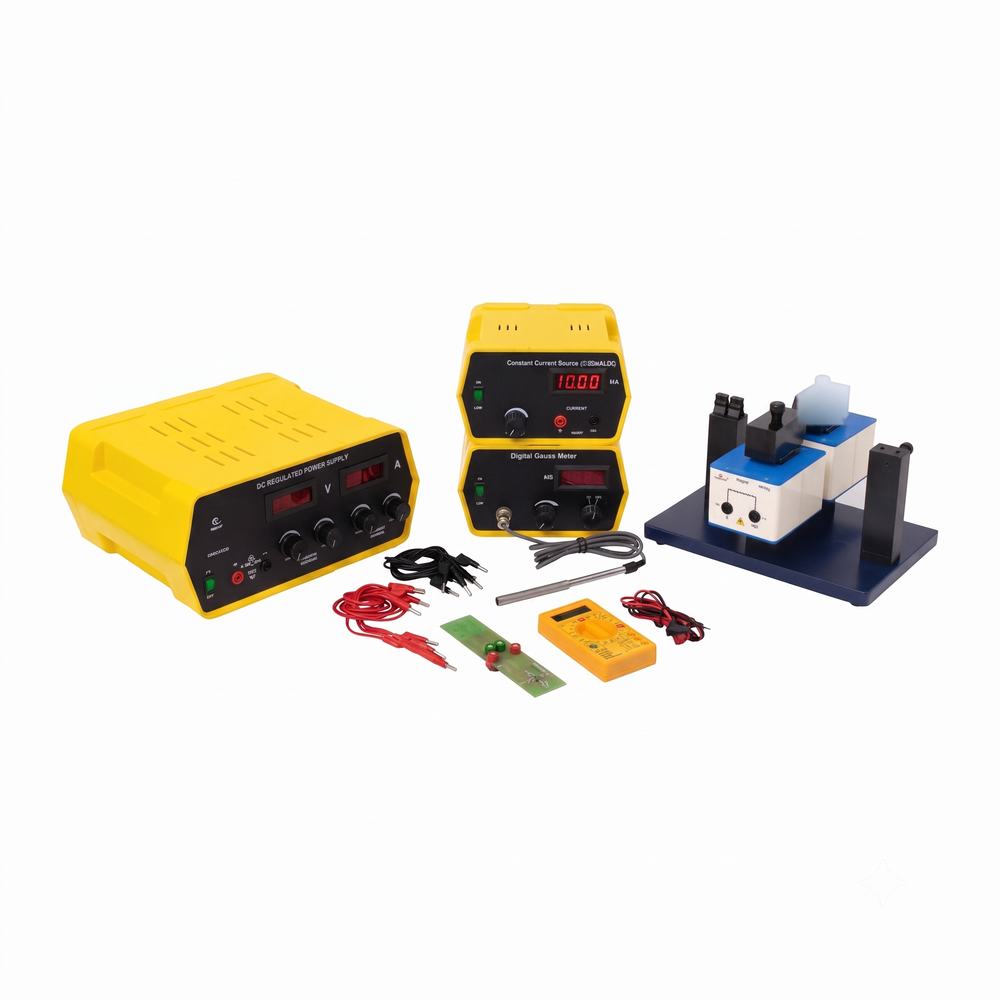
When a conductor through which current is flowing, is placed in the magnetic field, a potential difference is generated between two opposite edges of the conductor in the direction mutually perpendicular to both the field and the conductor. This potential developed is Hall voltage and the phenomenon is called Hall Effect. In the experimental setup, the crystal mounted on PCB is placed perpendicular to the pole pieces. A constant current is passed through the crystal using the constant current source. Magnetic field is produced by electromagnet operated by 0 – 12 V DC, 5 A power supply. Magnetic field intensity is measured by gauss meter with gauss probe. A Hall voltage thus produced is measured by the multimeter.
The following parts are included in Hall Effect Experiment:
PH93225H Hall Probe
PH61033D/5 Advanced Power Supply
PH93225E Electromagnet Setup
PH61500 Constant Current Power Supply
PH93225G Digital Gauss Meter
PH64505 3 ½ Digit Multimeter
PH93225 Hall Effect Experiment (Complete)
CSEEL provides turn-key science laboratory setup, teacher pedagogy training, and institutional quotation support.
Related Practical Apparatus
More equipment from Semiconductor Electronics